

Polyamory, Polygamy, and the Distribution of Sacred Creative Energy
Throughout history, mankind has experimented with many different forms of intimate relationships. From the plural marriages of ancient biblical patriarchs to modern polyamory and ethical non-monogamy, the question of whether a person can righteously maintain multiple intimate partners has remained a subject of fascination and controversy.
But perhaps we have been asking the wrong question.
Rather than asking whether society should permit these arrangements, or whether consenting adults have the right to pursue them, we should be asking something far more important:
What actually happens in the spiritual realm when one person enters into sacred sexual unions with multiple partners?
If sexual intimacy carries the spiritual significance of marriage, as we have previously discussed, then the implications of maintaining multiple intimate relationships extend far beyond jealousy, social expectations, or personal preference.
We are dealing with spiritual bonds, sacred responsibilities, and the creative energies through which God sustains His creation.
Can Multiple Sexual Unions Be Righteous?
Let us begin by establishing an important principle: Multiple sexual unions can be equally righteous when they are established and maintained in harmony with divine law.
Righteousness is not determined solely by the number of people participating in a relationship. It is determined by the intentions of their hearts, their faithfulness to their commitments, and their willingness to honor the spiritual responsibilities that accompany intimacy.
Scripture itself provides examples of plural marriages among individuals who played important roles in God’s covenant purposes. Abraham, Jacob, and David all participated in plural relationships, although their experiences also demonstrate the considerable challenges that accompany such arrangements.
We should be careful not to confuse God’s permission with His endorsement of every action taken within those relationships. Nevertheless, the biblical record gives us reason to examine plural marriage more thoughtfully than simply dismissing it as inherently unrighteous.
This does not mean that every form of non-monogamy is spiritually equivalent, nor that consent alone establishes righteousness.
A relationship can be consensual without being righteous, just as a legally recognized marriage can exist without genuine love, faithfulness, or spiritual harmony.
To understand the distinction, we must first examine the different forms of energy involved in intimate relationships.
Physical Love Energy Versus Spiritual Creation Energy
One of the most important distinctions we can make is between the energy required to sustain a loving relationship in the physical world and the raw spiritual creation energy released through sacred sexual union.
These are related, but they are not the same.
Physical love energy encompasses the time, attention, affection, patience, emotional availability, and daily acts of service that nourish a relationship.
These resources are limited by our mortal circumstances.
We have only so many hours in a day, so much physical strength, and a finite capacity to attend to the immediate needs of others. When an individual maintains multiple intimate relationships, these practical limitations become increasingly important.
A man with several wives, for example, cannot simply multiply the hours available to him. He must exercise greater discipline, organization, sensitivity, and fairness to ensure that each relationship receives the care it deserves.
Spiritual creation energy, however, operates according to a different understanding of divine law.
As we discussed in our examination of sacred sexual union, masculine and feminine energies come together to produce an extraordinary expression of creative life-force. Within this spiritual framework, that energy is not merely consumed and exhausted like physical strength.
It is released into creation, reverberating throughout the spiritual realm and returning with those blessings and substances necessary to support the righteous purposes from which it originated.
This distinction is essential.
The spiritual potential of a union is not necessarily diminished because an individual participates in another righteous union. But the physical responsibilities of maintaining those relationships must still be fulfilled.
A person may possess the spiritual capacity to participate in multiple sacred unions while lacking the emotional maturity, discipline, honesty, or practical resources to sustain them.
And this is where many relationships begin to encounter serious difficulties.
The Garden of Creation: Understanding Masculine and Feminine Energy
Consider for a moment the relationship between a gardener and the garden he cultivates.
A garden contains extraordinary creative potential. Within its soil exists the capacity to receive, nourish, transform, and bring forth life.
But a garden does not reach its fullest potential simply because that capacity exists.
It requires thoughtful cultivation, appropriate conditions, protection from destructive influences, and consistent attention to its unique needs.
The gardener, meanwhile, must understand the nature of what he is cultivating. He cannot simply scatter seeds indiscriminately, neglect his responsibilities, and expect a beautiful harvest.
He must exercise wisdom, patience, discipline, and a genuine appreciation for the life entrusted to his care.
Within the spiritual understanding we are exploring, the feminine energy resembles the fertile garden, while the masculine energy provides direction and initiates the flow of creative life-force.
This is not to suggest that women are passive recipients or that men possess greater spiritual worth. A garden is not an empty piece of land awaiting significance. It is a living, responsive environment with its own extraordinary intelligence, beauty, and capacity for creation.
Likewise, the feminine contribution is not merely to receive masculine energy, but to nurture, transform, magnify, and bring forth the possibilities contained within it.
In this model, masculine energy determines the initial direction of the creative current, while feminine energy provides the receptive and generative environment through which that current can develop.
Both are essential.
And when the two operate in genuine harmony, the resulting creation can become far greater than either could accomplish independently.
The Feminine Connection to the Creative Doorway
There is another aspect of feminine energy that deserves particular attention.
Within this spiritual perspective, women may possess a remarkable sensitivity to the receptive and generative dimensions of creation.
Women often express love through openness, emotional connection, nurturing, and a willingness to receive another person deeply into their lives.
These qualities are not exclusive to women, nor are they equally developed in every individual. Nevertheless, they offer a useful way of understanding the feminine role in the sacred exchange of creative energy.
As a woman develops greater spiritual sensitivity, emotional maturity, and awareness of her own divine nature, she may become increasingly conscious of the energies involved in intimate union.
Some may experience this as an extraordinary sense of spiritual openness—as though a doorway between the physical world and the heavens has momentarily become accessible.
The feminine becomes, in this understanding, a living garden in which the doorway to divine creation can be experienced.
Such experiences are deeply personal and cannot be assumed to occur in every woman or every intimate relationship. But within our spiritual framework, they point toward the extraordinary potential of feminine receptivity when joined with righteous masculine direction.
And this brings us to an important question:
What happens when these energies are exchanged among multiple partners?
One Man and Multiple Women: Cultivating Multiple Gardens
Imagine a skilled gardener entrusted with several beautiful gardens.
Each garden possesses its own character, requirements, strengths, and potential. One may flourish with abundant sunlight, another may require greater protection, and a third may need particularly careful attention to its soil and nourishment.
The gardener’s responsibility is not to force every garden into an identical pattern.
It is to understand each one, provide the conditions necessary for its flourishing, and maintain harmony across the whole.
In this analogy, a righteous man participating in multiple sacred unions resembles a gardener cultivating several gardens, each receiving its own care while contributing to a greater, unified purpose.
The masculine creative current has a common source of direction. Rather than several competing masculine intentions attempting to govern the same spiritual environment, the relationships can theoretically operate through a more unified pattern.
Each woman retains her individuality, her agency, her unique spiritual gifts, and her own relationship with God.
The objective is not to diminish those differences, but to create an environment in which each woman can flourish.
Of course, this arrangement places extraordinary responsibility upon the man.
He must possess the discipline to direct his energy righteously, the honesty to maintain genuine trust, and the wisdom to recognize the distinct emotional and spiritual needs of each partner.
He cannot favor one garden while allowing another to wither through neglect.
Nor can he claim spiritual authority as an excuse for selfishness, manipulation, or the avoidance of responsibility.
The measure of a righteous gardener is not the number of gardens he possesses, but the life, beauty, and abundance that flourish under his care.
The women, likewise, must freely choose the arrangement and participate in its shared purpose. Harmony cannot be established through coercion, suppressed resentment, or the sacrifice of one person’s dignity for another’s desires.
When all participants are genuinely aligned, this model offers a theological possibility: multiple distinct sacred unions receiving direction from a common masculine current, without necessarily diminishing the spiritual creative potential of any one relationship.
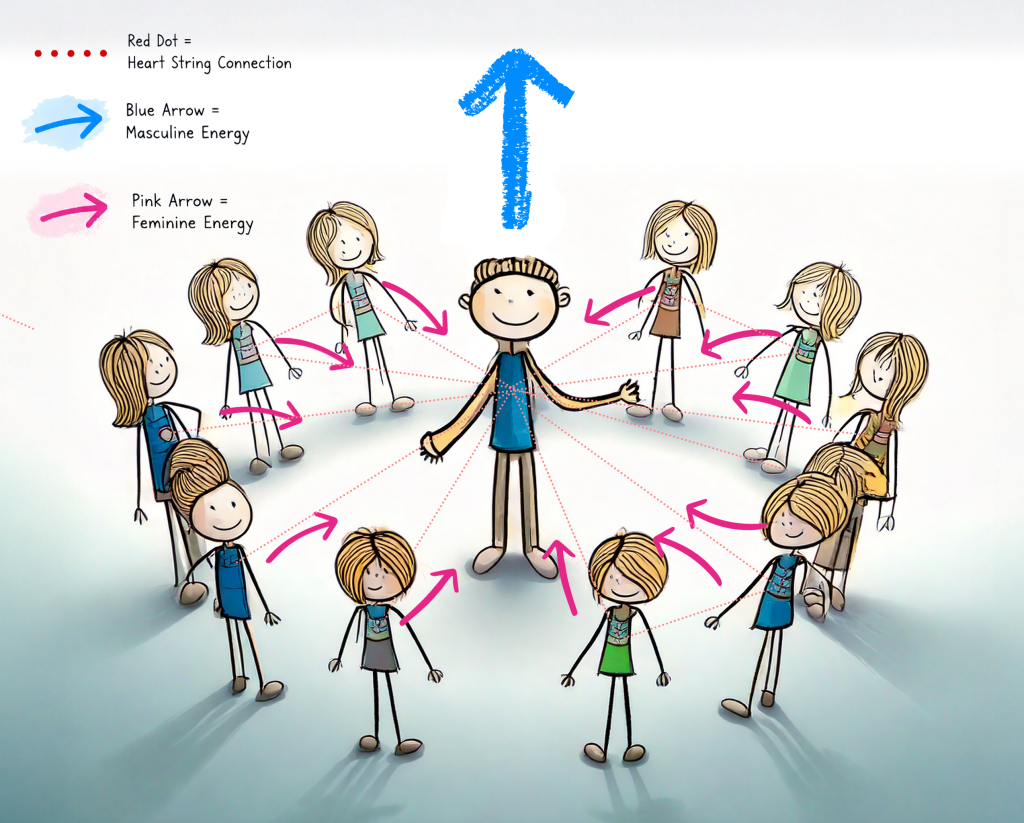
One Male – Multiple Females
One Woman and Multiple Men: Competing Directions in a Single Garden
Now consider a different arrangement.
Imagine a beautiful garden entrusted to several gardeners, each possessing his own ideas about what should be planted, how the soil should be cultivated, and which direction the garden should develop.
One wishes to grow an orchard. Another envisions a field of grain. A third wants to transform the same ground into a vineyard.
Each may be sincere. Each may possess valuable skills. But without an extraordinary degree of cooperation, their competing intentions can quickly undermine the very garden they wish to cultivate.
One gardener tills the soil while another plants. One removes what another has carefully nurtured. The result may be confusion, frustration, and wasted effort.
This analogy illustrates a potential difficulty within relationships involving one woman and multiple men.
Since masculine energy functions as the directional current of spiritual creation, then multiple masculine partners may introduce competing intentions into a shared receptive environment.
The difficulty is not necessarily a lack of love or goodwill. It is the challenge of bringing several independently directed creative currents into lasting harmony.
Throughout human history, competition between men for authority, resources, territory, and influence has contributed to countless conflicts and wars.
Of course, warfare cannot be reduced to masculine energy alone, and men are equally capable of extraordinary cooperation, sacrifice, and peace. Nevertheless, the destructive consequences of competing ambitions are difficult to ignore.
Within intimate relationships, similar tendencies may manifest as rivalry, possessiveness, conflicting expectations, or struggles over whose vision should guide the relationship.
A garden cannot flourish when its caretakers continually work against one another.
This does not establish that a woman with multiple male partners cannot experience a loving or righteous relationship. Rather, within the directional model of masculine energy being considered here, such an arrangement may face additional challenges in establishing a unified creative purpose.
Its success would require exceptional humility, cooperation, emotional maturity, and a willingness among the men to subordinate competing personal ambitions to a genuinely shared purpose.
Without those qualities, long-term harmony may be difficult to sustain.
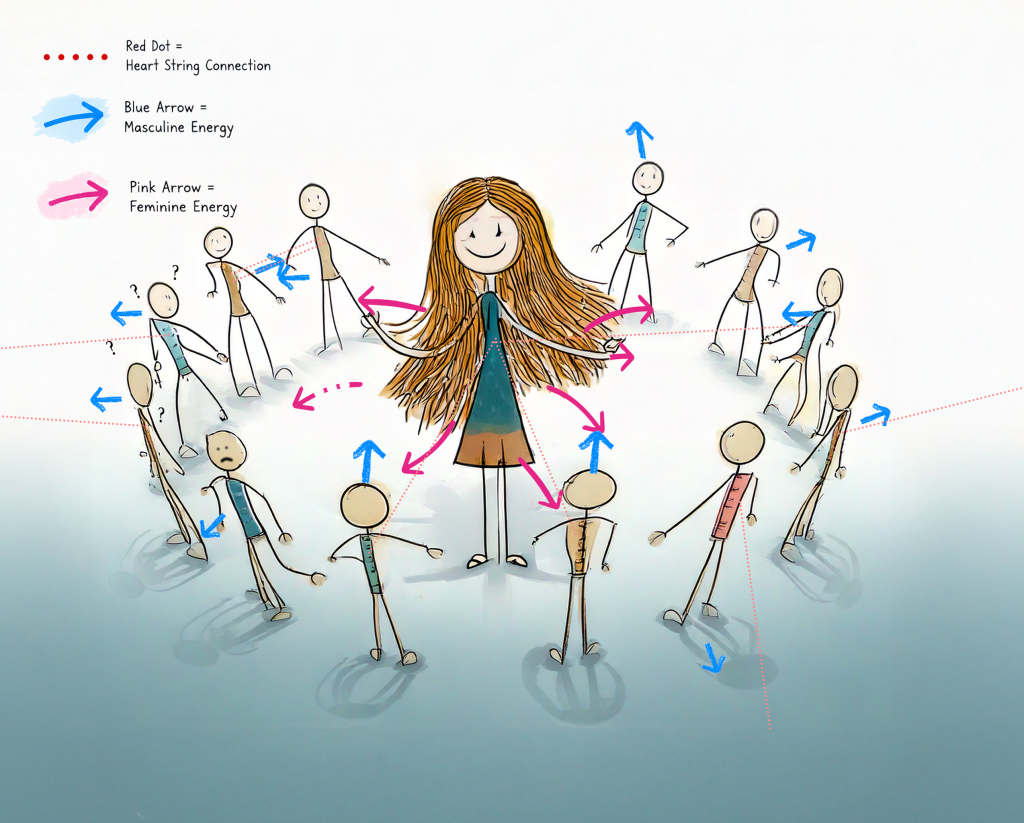
One Female – Multiple Males
Multiple Men and Multiple Women: A Complex Spiritual Ecosystem
What, then, of relationships involving several men and several women?
Here the garden analogy becomes even more complex.
Imagine a large estate containing numerous gardens, each with its own needs, while several gardeners move between them, contributing their labor, ideas, and creative intentions.
Such an arrangement might produce extraordinary beauty if every participant understood the larger design and worked cooperatively toward its fulfillment.
But the potential for conflicting intentions, neglected responsibilities, jealousy, and misunderstandings would also increase considerably.
Every additional relationship introduces new emotional obligations, new spiritual commitments, and new opportunities for both harmony and conflict.
The complexity is not necessarily evidence of unrighteousness.
Complexity, however, demands greater wisdom, not less.
A relationship involving multiple men and women could theoretically operate in harmony with shared spiritual principles, but its participants would need exceptional clarity about their commitments, boundaries, responsibilities, and intentions.
And where sacred sexual unions are involved, these questions carry consequences beyond the immediate satisfaction of physical desire.
The more intricate the relationships become, the more important it is that every individual understands the spiritual commitments being made.
The Greatest Challenge: Righteous Masculine Leadership
Before anyone concludes that a man with multiple female partners has discovered an easy path to spiritual abundance, we must confront an uncomfortable reality.
The greatest obstacle to righteous plural relationships may be the spiritual condition of the man himself.
Men can be remarkably capable of directing energy toward accomplishment, protection, provision, and creation.
But that same capacity for focused ambition can become destructive when separated from righteousness.
Consider how frequently masculine ambition becomes entangled with pride, competition, sexual gratification, secrecy, and the desire for control.
Men may conceal their intentions, compartmentalize their relationships, or rationalize dishonest behavior in pursuit of personal desires. These are human failings rather than universal male traits, but they are especially important to confront in any model that assigns men significant responsibility for directing creative energy.
A man who struggles to maintain honesty, faithfulness, and emotional responsibility within one relationship should be extremely cautious about assuming he is prepared to maintain several.
Adding more partners does not automatically produce greater spiritual power.
In fact, it may simply multiply the consequences of his existing weaknesses.
A gardener who cannot faithfully tend one garden has little reason to believe that acquiring three more will suddenly make him wise.
Spiritual authority without righteousness is not divine leadership. It is merely human ambition wearing religious clothing.
A truly righteous man must first learn to govern himself.
He must discipline his desires, purify his intentions, honor his commitments, and develop the humility necessary to recognize when his own ambitions are interfering with God’s purposes.
Only then can the possibility of responsibly directing multiple sacred unions even be considered.
Covenants, Agency, and the Return of Creative Energy
As we have previously discussed, sexual union in the physical dimension carries the spiritual significance of marriage.
This principle does not disappear when additional partners become involved.
If anything, the responsibilities become more significant.
Each sacred union represents a distinct commitment that must be honored. The existence of one relationship does not excuse the neglect or betrayal of another.
And when individuals have entered into higher covenants with God, their responsibilities become even more profound.
Within this theological understanding, the raw creative energy released through a pure sexual union reverberates throughout creation and returns with blessings capable of supporting and sustaining the righteous purposes from which it originated.
Multiple righteous unions could therefore represent multiple expressions of that creative process.
But the return of spiritual blessings should never be confused with a guarantee of material prosperity, nor should spiritual claims be used to pressure anyone into an intimate arrangement.
The Creator honors agency, and a union that depends upon coercion, deception, or manipulation cannot genuinely reflect the harmony of divine love.
The purpose of sacred creative energy is not to multiply our opportunities for pleasure, but to multiply the good we are capable of bringing into existence.
The greater the spiritual gifts we seek to exercise, the greater our responsibility to use them wisely.
The Ultimate Measure of a Righteous Union
Perhaps the most important conclusion is that we should be cautious about measuring righteousness according to outward relationship structures alone.
Monogamy does not automatically produce holiness.
Polygamy does not automatically produce spiritual abundance.
And consensual non-monogamy does not, by itself, establish either righteousness or unrighteousness.
Each relationship must be examined according to its intentions, its commitments, the character of its participants, and the fruits it produces.
Does it cultivate honesty or deception?
Does it encourage spiritual growth or selfish indulgence?
Does it strengthen the agency and dignity of everyone involved, or does it place some individuals in service to the unchecked desires of others?
Does it produce peace, stability, love, and genuine spiritual development?
Or does it leave behind jealousy, confusion, neglect, and broken commitments?
These questions matter far more than the labels mankind attaches to a relationship.
The garden of creation offers a beautiful illustration of this principle.
Whether we are entrusted with one garden or several, our responsibility remains the same: to cultivate life, protect what is sacred, and bring forth good fruit.
A righteous union is not defined merely by how many individuals participate in it, but by the harmony, faithfulness, and divine purpose that govern their relationships.
For in the end, the Creator will not judge the gardener by the number of gardens he claimed to possess, but by the care with which he cultivated them and the fruits they brought forth.